Look up the best time to post on Instagram and you get six answers that can't all be right. Later says 5 AM. Metricool says 8 PM. Sprout Social says Friday has no peak worth chasing, and Hootsuite hands you a Friday slot at 4 PM anyway.
So we stopped picking a favorite and stacked them. We took the newest edition of six big posting-time studies, wrote down every day and hour each one recommends, and counted the overlaps. When three companies with different customers land on the same hour, that's probably not noise.
Below: the consensus heatmap, a day-by-day cheat sheet, Reels and Stories, why the studies disagree, and how to find your own best time in Instagram Insights (which beats all six studies once you have the data).
Studies checked on October 7, 2026. All times are your audience's local time unless we say otherwise.
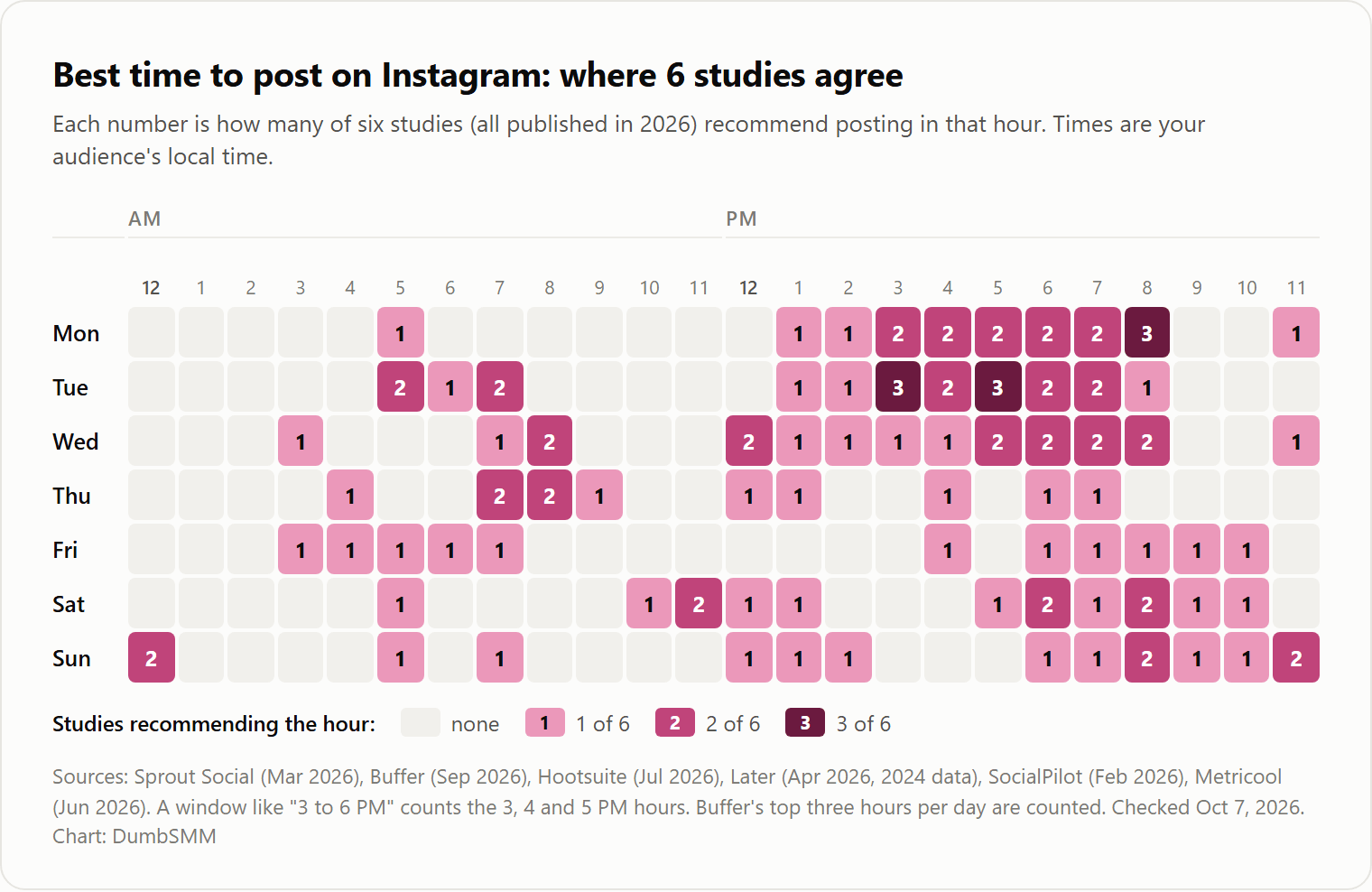
Heatmap of the best times to post on Instagram: how many of 6 studies recommend each hour of each day
Each cell counts how many of the six studies recommend posting in that hour. Three things jump out.
No hour wins a majority. The darkest cells (Tuesday 3 PM, Tuesday 5 PM and Monday 8 PM) get 3 votes out of 6. Anyone selling you "the" best time is selling you one study.
Evenings are the safe bet. 6 PM and 7 PM are the only hours that at least one study recommends on every day of the week. Add up the whole week and 6 PM and 8 PM collect the most votes (11 each), with 7 PM right behind (10).
And 1 AM to 2 AM is dead. Not one study recommends those hours on any day. The 9 to 11 AM stretch is almost as empty.
Here's our call:
Posting once a day? Post between 6 and 8 PM, in your audience's time zone.
Posting a few times a week? Use Tuesday at 3 or 5 PM, Monday at 8 PM, and Wednesday between 5 and 7 PM (four of the six studies recommend an hour in that Wednesday window).
Later's 2026 article runs on 2024 data. The title says 2026. The methodology says January to October 2024.
Hootsuite's 2026 page doesn't date its data. It calls the numbers "Hootsuite's 2025 social media analysis" and stops there.
Sprout's sample isn't Instagram-only. Those 307,000 profiles span six networks. Buffer's 9.6 million posts are all Instagram, pulled from a 52-million-post study across 10 platforms.
Local means local. Five of the six normalize to your audience's time zone, so "5 PM" means 5 PM wherever your followers live.
8 PM, backed by Buffer, Hootsuite and Metricool. Two studies also back every hour from 3 to 7 PM, so Monday is an afternoon-into-evening day. Later's 5 AM (and 11 PM) is the outlier.
3 PM or 5 PM, each backed by Sprout Social, Buffer and Hootsuite. Tuesday collects more total votes in the heatmap than any other day, and four of the five studies that rank days put it near the top. If you only post one great thing a week, post it here.
5 to 7 PM. No single Wednesday hour gets more than two votes, but four studies (Sprout, Hootsuite, Buffer and Metricool) back an hour inside that window. Noon (Buffer and Sprout) is the backup.
7 or 8 AM. Thursday is the morning day. Buffer says it's the only weekday where mornings beat evenings, and SocialPilot's 7 to 9 AM window agrees. Buffer's Thursday 9 AM is its best slot of the whole week.
Nobody agrees. Later likes 3 to 6 AM, Buffer likes 6 AM or 9 to 10 PM, SocialPilot 7 AM, Hootsuite 4 PM and Metricool 6 to 8 PM. Sprout sees no Friday peak at all and warns against 3 to 7 AM. Post if you have something, but don't save your best work for Friday.
11 AM, 6 PM or 8 PM (two studies each). Four of the five studies that rank days call Saturday the worst day of the week. Metricool is the lone dissenter and says Saturdays are as busy as weekdays.
8 PM (Buffer and Metricool), or late night at 11 PM and midnight (Later and SocialPilot). Sprout counts Sunday among the worst days, while Buffer calls Sunday evening the best weekend window.
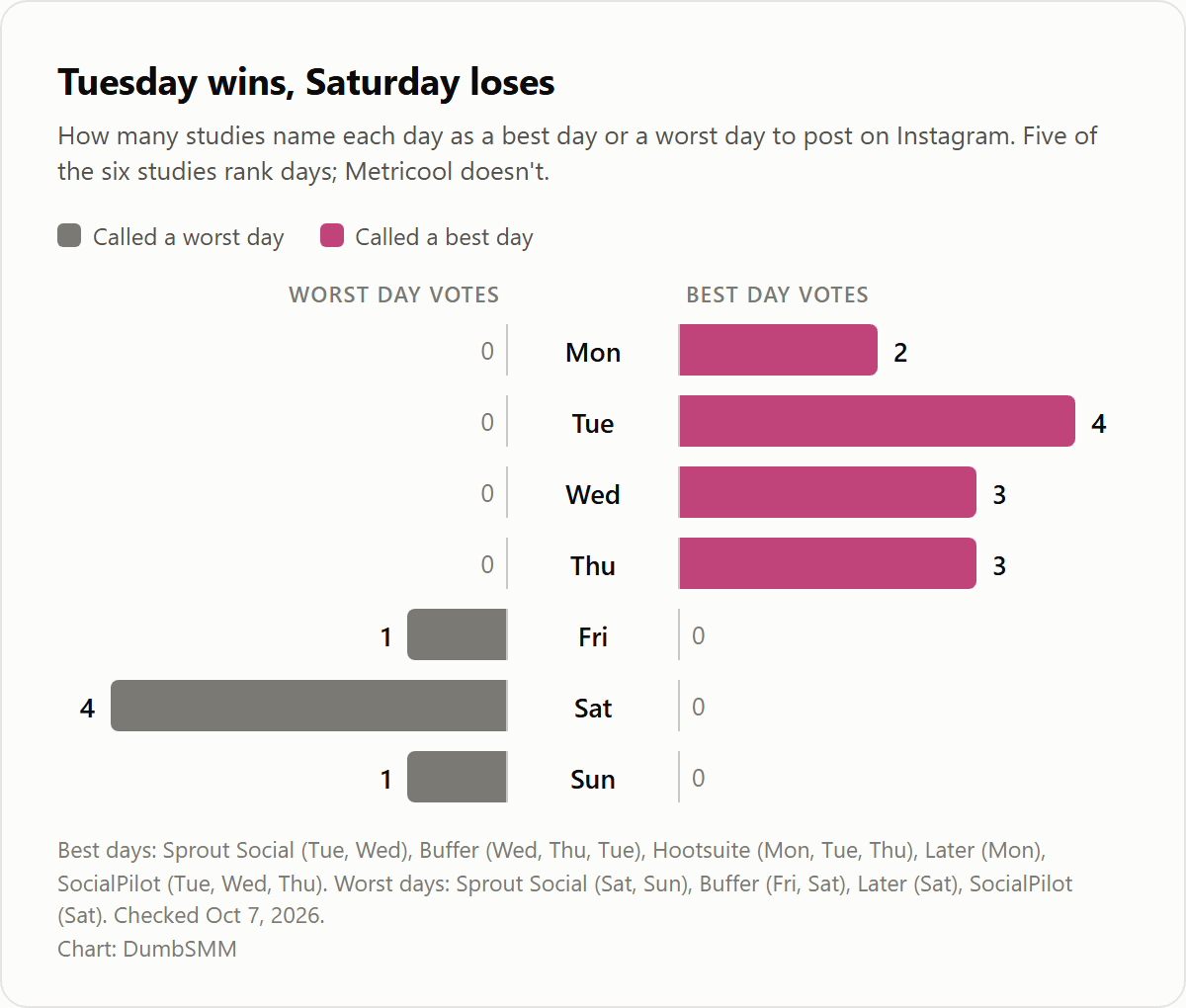
Bar chart: how many studies call each day a best or worst day to post on Instagram
Tuesday. Five of the six studies rank days, and four of those five put Tuesday among their best (Sprout, Buffer, Hootsuite and SocialPilot). Wednesday and Thursday get three votes each. Monday gets two, from Hootsuite and Later.
Saturday is the worst. Sprout, Buffer, Later and SocialPilot all put it at the bottom. Friday and Sunday get one "worst" vote each.
It's the one finding almost everyone agrees on: midweek wins and Saturday loses. If you're short on content, skip the weekend before you skip Tuesday.
Most studies don't split their data by format. Sprout and Buffer both say Reels follow the same times as everything else. The sources that do isolate Reels point somewhere else entirely: the middle of the night.
Source
Reels sample
Best time for Reels
Time zone
Later
975,000+ Reels (2024 data)
12 AM, best day Monday, 12 to 6 AM strong
Local
Metricool
2024 Short-Form Video Study
12 AM had the highest average views (25,159 per Reel), best day Sunday
3 AM ET for views (2.1x the views of 9 PM ET posts), 6 AM ET for likes
ET (fixed)
SocialPilot
250,000 Reels
8 AM to 12 PM, Monday to Thursday
Local
Sprout Social
All formats pooled
Same as overall (Tue 1 to 7 PM, Wed 12 to 9 PM)
Local
Buffer
All formats pooled
6 to 11 PM, Wednesday and Thursday
Local
Why would midnight work? Metricool's numbers hint at it. Only 34,131 Reels in its sample went up at midnight, against 119,705 at 6 PM, the busiest upload hour, where average views dropped to 15,928. Fewer Reels compete overnight, and that's Metricool's own explanation.
Our guess: Reels get pushed to people who don't follow you, many of them in other time zones, so your followers' bedtime matters less. Later makes a similar point about its biggest influencers, whose audiences are spread so wide that someone is always awake. Adobe's sample is 149 of the biggest creators on the platform. Your account probably isn't one of them.
If your Reels mostly reach non-followers, test a late-night or very early slot against your usual evening one for a few weeks. If they mostly reach followers, stick to the feed windows above.
Stories go to people who already follow you, and they vanish after 24 hours. Lunchtime is the closest thing to agreement: SocialPilot's Stories windows sit around 11 AM to 2 PM on Monday, Wednesday and Thursday, and Metricool says 11 AM to 2 PM every day. Later suggests 6 to 8 AM and 7 to 9 PM but shows no data for it. Buffer skips the question and says to post one or two Stories a day.
Carousels follow the feed pattern. Later says 5 AM on Tuesday, SocialPilot says 7 to 9 AM Tuesday to Thursday, and Buffer says its midweek feed slots apply.
Nobody's lying. They just measure different things.
They don't share a clock. Five studies normalize to the audience's local time. Metricool doesn't name a time zone, and Adobe's Reels data is in Eastern Time.
They score posts differently. Buffer uses median engagement rate (likes, comments, shares and saves divided by followers). Later and SocialPilot also use engagement rates, Sprout counts engagements, Metricool tracks when interactions pile up across the whole platform, and Hootsuite doesn't say. That's how Later can crown 5 AM while Metricool calls 2 to 5 AM a dead zone: a 5 AM post has little competition and gets seen when people wake up, so its rate looks great while the app itself is quiet.
They see different accounts. Each study only sees its own customers, with its own mix of brands, creators, industries and countries.
The data comes from different years. Later's stops in October 2024. Sprout's runs from late November to late February, holidays included. Buffer's covers two full years.
They round differently. Some publish one hour per day. Sprout's Wednesday window is nine hours long.
That's why we trust the overlap more than any single study, and why your own data beats all of them.
Some. Less than the post itself. Instagram says each part of the app (Feed, Stories, Explore, Reels) ranks content with its own system, and for Feed, when a post was shared is one of thousands of signals (Instagram Ranking Explained, 2023). Even Buffer, which sells scheduling, says content matters most.
Good timing buys a post a better first hour. It won't rescue a boring one.
Instagram already shows you when your followers are online. Here's where it lives, per Instagram's help center:
Go to your profile (tap your profile picture, bottom right).
Tap Professional dashboard. On a personal account it's called Your dashboard. Don't see it? Open the menu, go to Settings and activity, and tap Insights under For professionals.
Open your follower insights. Instagram's insights overview says the Total followers view shows growth, top locations, age range, and the times your followers are most active on Instagram.
Find the peaks. Note the 2 or 3 busiest hours on your best days. Those are your candidate slots.
Two catches: the follower view needs at least 100 followers, and Insights only looks back 90 days. Your account also has to be public. Under 100 followers? Use the consensus slots until you cross it.
Then test it. For four weeks, alternate between your Insights peak and a consensus slot (Tuesday 5 PM, or 6 to 8 PM). Keep the format the same so you're testing the time, and compare reach after the same number of hours. If your Insights disagree with this article, believe your Insights. Even Later tells readers to trust their own analytics over its study.
The slot follows your followers, not you. If your audience is on the US East Coast and you aren't, here's what to set on your clock:
Consensus slot (audience in ET)
Eastern (ET)
Central (CT)
Pacific (PT)
GMT
Tuesday, best slot
3 PM
2 PM
12 PM
8 PM
Tuesday, best slot
5 PM
4 PM
2 PM
10 PM
Monday, best slot
8 PM
7 PM
5 PM
1 AM (Tuesday)
Wednesday window
5 to 7 PM
4 to 6 PM
2 to 4 PM
10 PM to 12 AM
Thursday morning
8 AM
7 AM
5 AM
1 PM
Daily window
6 to 8 PM
5 to 7 PM
3 to 5 PM
11 PM to 1 AM
The GMT column uses US standard time, which starts November 1, 2026. During US daylight saving time (March 8 to November 1, 2026), subtract one hour from it.
Followers on both coasts? Try Tuesday at 6 PM ET, which is 3 PM PT. Both ends land in hours the studies back: 6 PM gets Sprout and Hootsuite, and 3 PM gets Sprout, Buffer and Hootsuite. Monday at 8 PM ET (5 PM PT) works the same way.
We built DumbSMM, and it has a social media scheduler that posts to Instagram, TikTok and YouTube from one calendar. You set the time slots in your own time zone, or pick how many posts a day you want and let AutoPost drop your approved videos into the next open slots. Nothing goes out that you haven't reviewed.
Need Reels to fill those slots? The free clip maker turns a YouTube link or an uploaded video into captioned vertical clips, and the short video maker builds short videos from your website. Both are free.
To be fair, DumbSMM won't calculate your personal best time. Instagram Insights does that for free, Hootsuite and Metricool can suggest times from your own account's data, and Buffer can load its study's recommended slots into your queue. Get the time from whichever you like, then let the scheduler post at it while you sleep.
Monday: 8 PM. Tuesday: 3 or 5 PM. Wednesday: 5 to 7 PM. Thursday: 7 or 8 AM. Friday has no consensus, so try 6 to 8 PM. Saturday: 11 AM, 6 PM or 8 PM. Sunday: 8 PM. All in your audience's local time.
Tuesday. Four of the five studies that rank days (Sprout Social, Buffer, Hootsuite and SocialPilot) put it among their best. Saturday is the worst, according to Sprout, Buffer, Later and SocialPilot.
1 AM to 2 AM. None of the six studies recommends those hours on any day. Buffer calls 1 to 5 AM the worst stretch, and Metricool calls 2 to 5 AM a dead zone. Reels are the exception, where some data favors midnight to 3 AM.
At night, for most accounts. The 6 to 8 PM stretch collects the most recommendations across the week. Thursday is the exception: Buffer and SocialPilot both favor 7 to 8 AM.
The Reels-only data points late. Later says 12 AM, Metricool found the highest average views at 12 AM, and Adobe's study of top creators found 3 AM ET. SocialPilot says 8 AM to 12 PM, Monday to Thursday. Test a late slot against your usual evening one.
Your audience's local time. Sprout Social, Buffer, Hootsuite, Later and SocialPilot all normalize to local time, so 5 PM means 5 PM where your followers are. Metricool doesn't name a time zone, and Adobe's Reels study uses Eastern Time.
Open your profile, tap Professional dashboard, and open your follower insights. Once you have 100 followers, Instagram shows when they're most active. Post a little before those peaks and compare against a consensus slot for a few weeks.


 DumbSMM Team